

 After months of communicating by text, we finally get to meet Abdoul in person. He will be with our group for the next 2.5 weeks. But first, he is going to be our personal guide for the next few days. His big smile is the first thing we notice about him. Wow, so kind and welcoming as he loads our things into the Land Cruiser. Our first stop is to pick up Robin, another lady from our larger group who is coming on this three day adventure with us. Then we’re off.
We have a very long drive ahead of us and a few stops along the way. As we are driving through Kigali, this time in the daylight, we are able to see just how clean this city is. There are workers everywhere sweeping the roads, the sidewalks, the ditches, everything. The city is filled with decorative art pieces, beautifully sculpted buildings and manicured parks. The roads are smooth and paved, such a contrast to the small towns of Tanzania.
 Rwanda is known as the land of a thousand hills and as we leave the city, it is easy to see why. Hills and more hills for as far as the eyes can see. Even as we’re driving we didn’t hit a flat piece of land once. If you’re not going up, you’re going down. Over and over again. Just outside of the city, the hills are covered in farmland being worked on, by hand, by dozens of workers. Not a machine in sight.
 Everybody here works so hard. The majority of the population doesn’t own a car so to get around they walk or ride a bike. If they’re lucky, they’ll have a motorcycle. We’d pass by people pushing their fully loaded bikes up these enormous hills and then carefully down the other side. There are taxi bikes where the cyclist would carry his passenger up and down these hills. The strength and stamina of these people is incredible. Always in motion, always working, always climbing a hill.
 The King’s Palace, our first destination, is only 100km away. However, it took us the better part of three hours to make the journey. The roads were great, but you can’t go faster than 60km/hour and you’re lucky if you’re able to reach those speeds at all considering the amount of people on the roads. The twists and turns of the roads don’t help and the numerous delivery trucks are so laden down with products that they often get stuck going up a hill. By consequence, we’d be stuck behind them. It was a slow going adventure, that’s for sure. On the bright side, we were able to really take in the scenery passing us by.
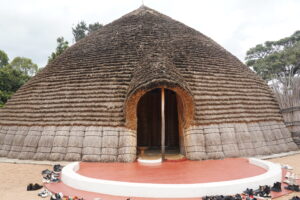 Our hour long visit at the King’s Palace turned into two hours as our guide was quite verbose and we were very curious. Lots of questions asked and thoroughly answered. It started at a replica of the traditional King’s Palace, a large hutlike structure that would be surrounded by many other huts housing many different people in charge of various things.
 A virgin, for example, lived in a special hut to look after the king’s milk. Yep, it was her job to specifically look after the milk. Another hut housed a gentleman to look after the beer. Other huts housed the wives – one hut/wife, of course. Then, of course, there were huts for the advisors, staff, chefs, etc. All of these separate huts were surrounded by one large fence for security. It was like a little King’s Village.
 Then we went to the actual house of their last king. It was built by the Belgians and was gifted to him when he was just a young man. It had none of the traditional feel of the last kings’ palaces. It was the end of a way of life when this happened. A lot of the Rwandan culture and traditions were lost, ignored or changed. When this last king died in 1959, the monarchy died with it.
 The last part of our tour brought us to the Royal Cows, the Inyambo. These are some fascinating animals. Their horns can grow to over two feet long. They are looked over by a dedicated caretaker. He sings to them, plays them music on his fiddle, massages them, and makes sure all of their ‘needs’ are met. They are not bred for milk nor meat. Instead they are purely a symbol of wealth. It costs a lot of money to raise them and you don’t get any income from them. We got to pet them, scratch their ears with a special brush and meet the babies. The young loved to use our arms as a saltlick with their super rough tongues.
Seeing this piece of history was very interesting and we learned so much, but the standout memory for us? We ran into a group of students on a field trip. There were about thirty 5-7 year olds at the palace just ahead of us; when they saw us, we were surrounded and swarmed with hugs and high fives. It was such a warm welcome and we loved it.





0 Comments