
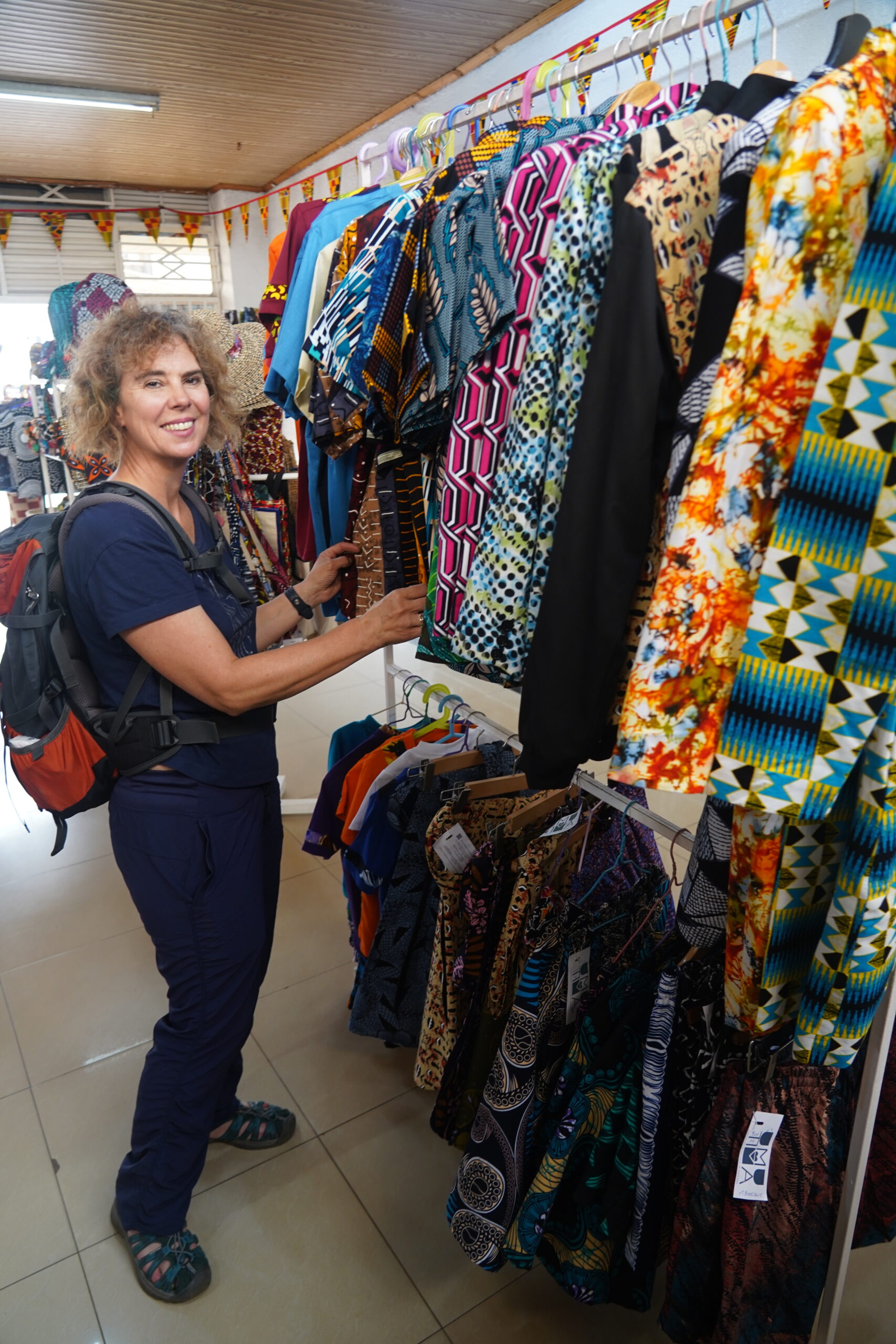
 This is turning out to be such a special day! After our amazing, and plentiful, lunch, we walk back to the Women’s Center, which is really just across the street, to start our afternoon activities. Weaving class is first. But…once inside the building, we are extremely distracted by the handmade items in the shop.
 I guess we’ll do some shopping first! Everything we see is made by the women they had once trained in the sewing room just beside the shop. There are men’s shirts, women’s dresses, hats, table linens, bags, baby items, toys, book covers, wallets, and so much more. We shopped and shopped and shopped picking up most of our gifts here. We also got measured to have shirts, bathrobes and a dress made.
  We got to choose our fabrics; we went as neutral as possible for the clothing items and went crazy for the bathrobes. You gotta have fun in life!
Our guide, Shadia, waited patiently while we bought everything we saw in the shop and took us to another room for our weaving class. Weaving is another cultural art here. There are woven baskets, bags, containers, plates, decorations, etc. We can choose between earrings that are about an inch in diameter or a necklace pendant that is two inches. Seems like such a small project. It’ll take us no time at all!

 We chose the necklace pendant, figuring we can use it as a tree ornament for our Travel Christmas Tree. First step is to choose our colours – up to two – from the sisal fibres already dyed for us. Shadia showed us how to get started and we were off to the races.
Well, let’s just say, that although the process is quite simple and straightforward, it is very difficult to do it well. You need a huge amount of patience and eye for detail to get your stitches even and tight and uniform. It took us over two hours to make these teeny two-inch discs, and Shadia did all of the difficult parts for us – starting them, transitioning the colours and tying it off at the end. Now we understand why baskets and plates were not on offer for us. LOL. Still, we were very proud of our work – they will have a position of honour on the Christmas tree. Maybe.
Our last activity for the day was a tour around their neighbourhood, Nyamirambo and a glimpse into the lives of the locals. Nyamirambo means “the place of the dead people”, not a very flattering name to say the least. However, when the government tried to change it, the people protested. They preferred to keep it because it honours those people who died in the war there…from 400 years ago!
 Shadia was a great guide, showing us a few things that we would not have noticed ourselves. First up was the Milk Bar. This is a place where the government subsidizes the cost so that locals have access to healthy milk. The motto for this initiative is “One family – one cow”. Milk is a big deal in Rwanda and is used as a drink of respect when needed. This goes back to the days of the monarchy when milk was a royal drink.
Farmers are paid by the gov’t to bring their milk here and it is put in a huge cauldron. The locals can then come with a container – any container will do (a water bottle, a jerry can, a bowl, etc) – and fill it for a very low price to bring home. Alternatively, people will show up with a cup and a friend and they can get a glass of milk, sit at the table and have a nice visit. Many squabbles are resolved over a glass of milk at the Milk Bar. Now that we know what they are, we see them everywhere!
 Shadia then showed us one of the community water taps. Even though we are in a big and modern city, not everyone has access to running water in their home. People still have to come here 2 or 3 times a day to fill their jugs for daily use. These taps are placed every few blocks or so, so they don’t have very far to travel (unlike those living in remote villages where they may have to walk 3-4km!) but it is still a huge inconvenience and time sucker. It costs 20 Rwandan Francs (about 2 cents) for 20L. The government is working very hard to keep the water affordable and as accessible as possible.

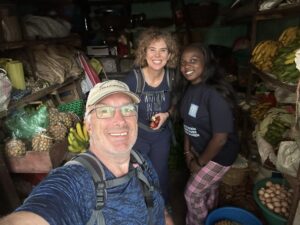 While we were walking through her neighbourhood, visiting local hair salons, seeing the viewpoints, smelling the fresh produce, seeing the children playing in ‘their’ street and passing by all the restaurants, Shadia spoke very highly of their government. After the genocide, the president, Paul Kagame, has been working very hard to unite all Rwandans as one people and Shadia is seeing that progress. She was also very impressed that the president will take the time to visit individual communities and villages, find out what they need and put forth a plan to fix it. He really hears people’s concerns and actively works towards solving problems. In Shadia’s words, he is the man this country needs and they are lucky to have him.
We finish up our very long day with a supper in one of the neighbourhood restaurants, letting everything we’ve experienced and learned soak in. Wow. What a day. Again.





0 Comments